
Most OEM welding hose disputes are not quality failures. They are specification gaps — something both sides assumed, neither side wrote down, and the factory resolved in whichever direction was cheapest. A purchase order that names all twelve items below removes almost all of that risk.
This list is written from the manufacturing side. It is the information we actually need before we can quote firmly, and the order in which we usually have to go back and ask for it.
The 12 points
- Fuel-gas grade (R / RM / T)
- Standard to build and certify to
- Bore size and tolerance
- Working and burst pressure
- Tube and cover compound
- Reinforcement type and density
- Cover colour for the destination market
- Wall thickness and OD tolerance
- Printed or embossed legend
- Length, coil format and cut tolerance
- Fittings and safety devices
- Packing, marking and test documents
01Fuel-gas grade (R / RM / T)
If you sell into North America, this is the first question and it is a safety question, not a commercial one. The RMA/CGA IP-7 grading system splits welding hose three ways:
| Grade | Tube | Cover | Fuel gases |
|---|---|---|---|
| R | Not oil or flame resistant | Not oil or flame resistant | Acetylene only |
| RM | Not oil or flame resistant | Oil and flame resistant | Acetylene only |
| T | Oil and flame resistant | Oil and flame resistant | All fuel gases |
The practical consequence: if your end users run propane, propylene, MAPP or LPG rather than pure acetylene, Grade R and RM are not appropriate. Those gases attack a non-oil-resistant tube from the inside, and the hose can fail without any visible warning on the cover. CGA Safety Bulletin SB 11-4 goes further and recommends Grade T exclusively for all oxy-fuel work.
02Standard to build and certify to
Grade and standard are different things. The grade describes compound behaviour; the standard defines dimensions, pressure testing, ageing, adhesion and marking. The one your market expects depends on where the hose is sold, not where it is made.
For most of Europe and any market that follows CEN, that standard is EN ISO 3821. Its current edition covers normal duty at 2 MPa (20 bar) working pressure, plus a light-duty class limited to 1 MPa (10 bar) with a bore up to and including 6.3 mm, for service between −20 °C and +60 °C.
03Bore size and tolerance
Specify the nominal inside diameter in both inches and millimetres, and state the tolerance you will accept. The common range for twin welding hose is 3/16" (4.8 mm) through 1/2" (12.5 mm), with 1/4" and 3/8" carrying most of the volume.
Bore tolerance matters more than most buyers expect. An oversize bore will not seat correctly on the hose tail and shows up as slow leaks in the field; an undersize bore makes assembly slow and can split the tube during crimping. If you are crimping your own fittings, give the factory the fitting drawing — the bore should be specified to suit it.
04Working and burst pressure
State both, and state the safety factor you require between them. The common commercial specification is 20 bar (300 psi) working pressure against a 60 bar (900 psi) minimum burst, giving a 3:1 ratio.
Ask two follow-up questions that separate serious factories from resellers: is every coil proof-tested, or only a sample? And is the burst figure a design value or a measured one? Our own answer is that every coil is hydrostatically proof-tested at rated working pressure before packing — but you should be asking that of everyone you quote, not just us.
05Tube and cover compound
The compound determines almost everything about how the hose behaves in service, and it is the easiest place for a supplier to save money without it being visible on arrival.
| Compound | Strengths | Watch for |
|---|---|---|
| SBR | Low cost, good abrasion and flex | Poor oil and fuel resistance on its own |
| NBR | Oil and fuel gas resistance | Cost; usually blended rather than used alone |
| SBR + NBR blend | Balances cost against fuel resistance | Blend ratio is rarely disclosed — ask |
| EPDM | Excellent weather and ozone resistance | Not oil resistant; wrong choice for oily fuel gases |
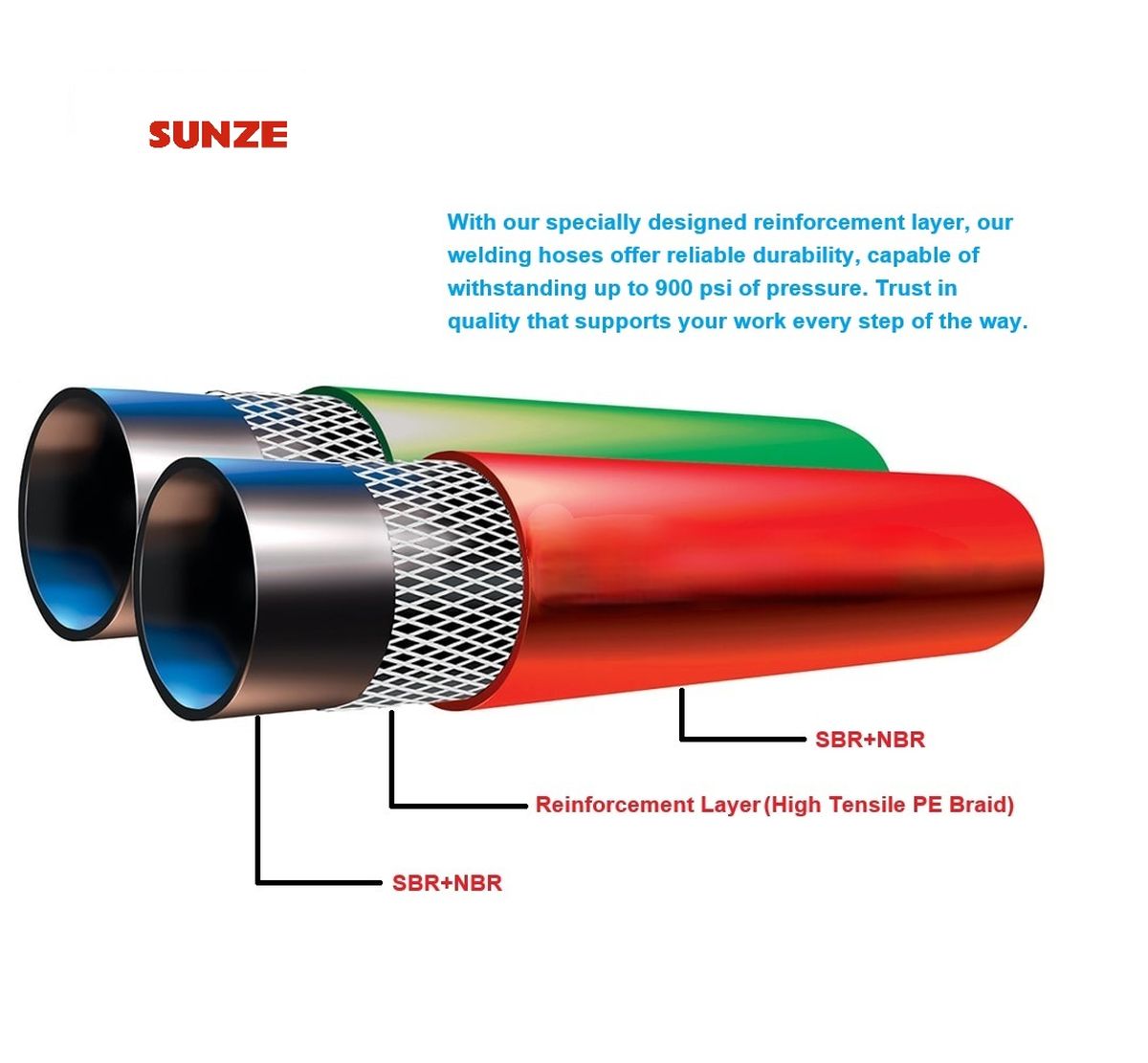
Ask for the compound of the tube and the cover separately. They are frequently different, and a quotation that only names one is hiding the other. Our twin welding hose construction uses an SBR+NBR blend on both, which is why the bore tolerates fuel gases beyond acetylene.
06Reinforcement type and density
The reinforcement layer carries the pressure. Twin welding hose is normally braided with high-tensile synthetic yarn — polyester or PE — rather than steel wire, because the hose has to stay flexible and light at the torch end.
Braid density is where quiet cost-cutting happens. A looser braid pitch uses less yarn, passes a burst test on day one, and fatigues faster in real service. If you have had a previous supplier whose hose stiffened or ballooned after a season, this is usually why. Specify the reinforcement material and ask what the braid pitch is; a factory that cannot answer is not making it.
07Cover colour for the destination market
Colour is a safety code, and it is not the same everywhere. Getting this wrong makes the shipment unsellable, not merely unattractive.
| Market convention | Fuel gas line | Oxygen line |
|---|---|---|
| ISO / European practice | Red | Blue |
| US practice (CGA / ANSI Z49.1) | Red | Green |
Red for fuel gas is essentially universal. The oxygen line is what changes. Name the destination country on the RFQ and let the factory confirm the convention rather than assuming your own market's colours travel. If you sell into several regions, it is usually cheaper to run two colour variants than to argue with a customs inspector.
08Wall thickness and OD tolerance
Two hoses can share the same bore and the same burst rating and still be very different products. Wall thickness drives kink resistance, weight, how the hose behaves in cold weather, and how long the cover survives being dragged across a fabrication floor.
It also drives your freight cost. A thicker wall is a better hose and a heavier container. Decide which trade-off you want rather than letting the factory decide it for you, and put the OD tolerance on the order if your fittings or reels depend on it.
09Printed or embossed legend
The continuous legend along the cover is what makes the hose yours. It is also what a safety inspector reads. A complete legend usually carries:
- Your brand name
- Product description and nominal size
- Grade designation, where applicable
- Standard reference
- Maximum working pressure
- Production date or batch code
- Country of origin
Decide early whether you want the legend printed (sharper, more colours, wears with abrasion) or embossed into the cover (lower contrast, effectively permanent). Send artwork as vector, not as a photo of an existing hose — and check the legend on the first-article sample character by character. A typo found at sample stage costs nothing; the same typo found on a full container is a reprint of the entire run.
10Length, coil format and cut tolerance
Specify cut length, the tolerance on it, and how you want it presented — loose coil, shrink-wrapped coil, carton, or wooden reel. Common retail cut lengths run from 3 m to 100 m; bulk buyers usually take longer continuous coils and cut locally.
State the tolerance explicitly. "25 metres" with no tolerance invites a factory to ship 24.6 m, which is legal in most jurisdictions and unacceptable to a retail buyer whose packaging says 25 m. If you are selling in feet, give the target in feet and let the factory convert — not the other way round.
11Fittings and safety devices
Decide whether you are buying bare hose in coils or finished assemblies. If assemblies:
- Connector thread — 9/16"-18 UNF is the common oxy-fuel size in the US (A and B variants), while G1/4 and G3/8 appear in other markets. Name the thread, do not describe it.
- Ferrule type and crimp specification — and who supplies the fittings, you or the factory.
- Check valves and flashback arrestors — whether they are fitted, at which end, and to which standard. In several markets these are mandatory rather than optional.
Assemblies shift liability. If the factory crimps it, the factory owns the joint; if you crimp it, you do. Be deliberate about which you want.
12Packing, marking and test documents
The last item on the list is the one that most often delays a shipment at the destination port. Specify:
- Inner packing and carton quantity
- Carton marking, barcodes and any retail labelling
- Pallet or container loading plan
- Which documents ship with the goods — test reports, material declarations, certificate of origin
Ask for the test documentation format before production, not after. A factory that pressure-tests every coil can give you a batch report; one that cannot will offer a generic type-test certificate instead, and the difference only becomes obvious when your customer asks for traceability on a specific reel.
What ours looks like. Our twin welding hose with brass fittings was proof-tested by SGS Taiwan (Material and Engineering Laboratory, Taichung) at 900 psi held for one minute, with no cracks or leaks — report TV-24-02528, issued 28 June 2024. Read the report in full (PDF, 2 pages). Ask any supplier you are evaluating for the same three things: a named laboratory, a report number, and a date. A supplier who can only offer a logo has not been tested.
Using this list
You do not need all twelve answers to start a conversation. Points 1, 2, 3, 7 and 10 — grade, standard, bore, colour and length — are enough for a factory to quote something meaningful. The remaining seven are what turn a quotation into a specification you can hold a supplier to.
If a supplier resists putting any of these in writing, that is information. The items above cost a real manufacturer nothing to confirm, because they are decisions being made on the production floor anyway.
Send us the checklist
Fill in as many of the twelve points as you have decided and we will quote against them — including where we think a different choice would serve you better.
Get a Factory QuoteBack to Factory-Direct Oxy-Acetylene Twin Welding Hose for the full specification range, manufacturing process and FAQ.